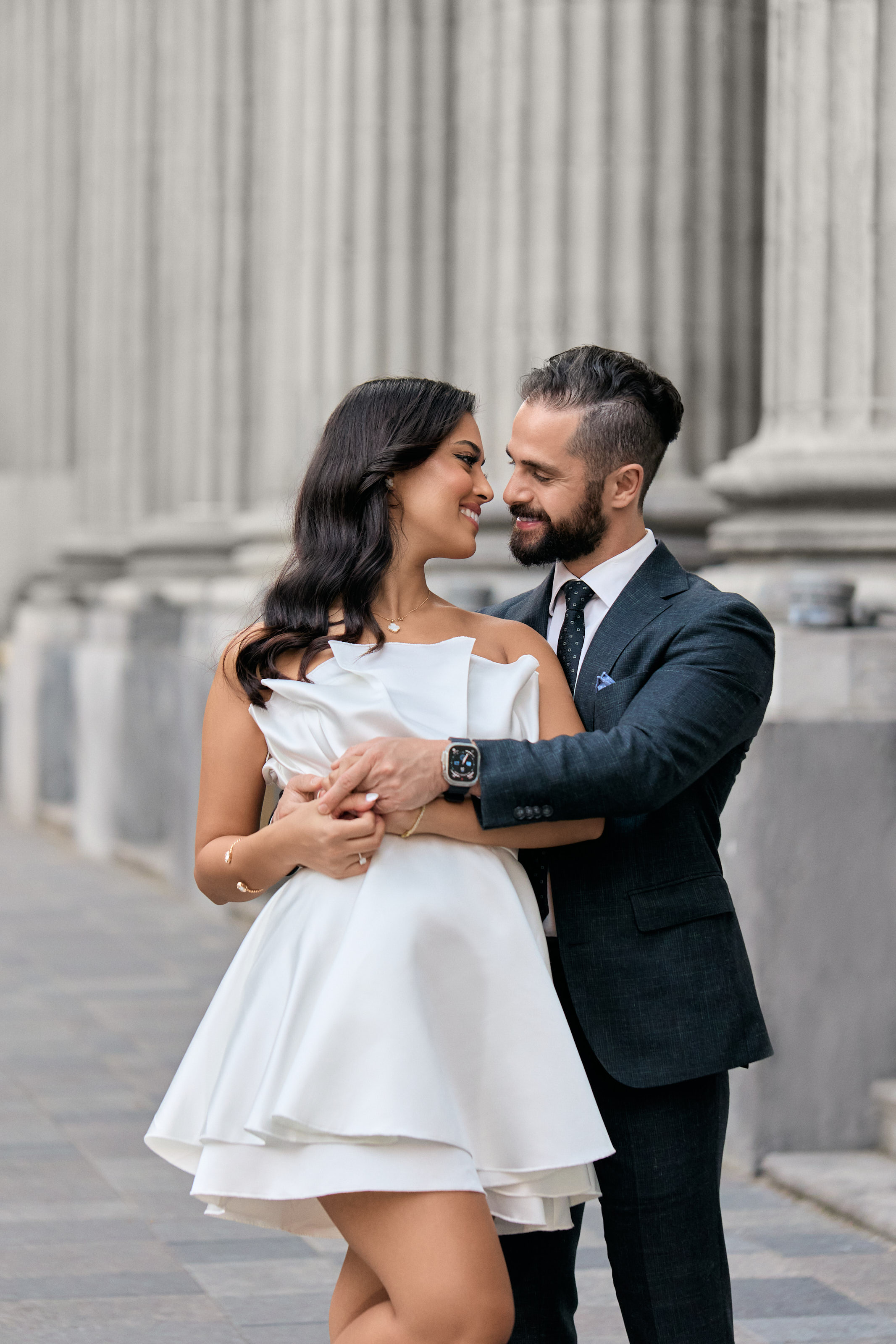
A courthouse wedding is the simplest way to get legally married in Montreal: a short civil ceremony at the Palais de justice, your two witnesses, a few people you love, and the rest of the day is yours. It's also surprisingly confusing to plan. The rules are spread across the Civil Code, the Directeur de l'état civil and the Ministère de la Justice, and many guides online quote old fees or contradict each other on basic things, like which days ceremonies are held. This guide puts the official rules in one place, in plain language, and every source is listed at the end so you can check them yourself. I've also added what I know as a photographer: how to plan your photos around a ceremony that's over in a few minutes.
A quick note: this is general information, not legal advice. The legal rules and fees below come from official Quebec sources checked in September 2026. For your own situation, the courthouse or a notary can confirm the details.
How a courthouse wedding works in Quebec
In Quebec, a marriage has to be celebrated openly, in front of two witnesses, by a competent officiant.[1] For a civil ceremony, that officiant can be a clerk or deputy clerk of the Superior Court (the courthouse option), a notary, a mayor, a municipal or borough councillor, a municipal officer, or a friend or relative designated for the day.[1][2] There's no marriage licence in Quebec. Instead, a notice of your marriage is published on the Directeur de l'état civil's website for 20 days before the ceremony.[1][3]
The short version
- Book an interview with the clerk. You call the courthouse, and the date of your ceremony is set during the interview, based on the clerk's availability.[4][6]
- Publish the notice. It must be online for 20 days before the wedding, and you must marry within three months after that, or publish it again.[1][3]
- Bring your witnesses. Two at the ceremony, plus one adult to confirm the information in your notice (courthouse staff can do it if you don't have one).[1][6]
- Pay the government fee. It's set by Quebec and changes every January 1.[10]
- The paperwork is sent for you. After the ceremony, the officiant sends the declaration of marriage to the Directeur de l'état civil within 30 days.[1][15]
Three ways to have a civil wedding in Montreal
1. A court clerk at the Palais de justice
This is the classic courthouse wedding. A clerk or deputy clerk of the Superior Court marries you at the courthouse, in French or English.[5][9] It's simple and affordable, but you work with the courthouse's schedule: the clerk sets the date based on availability, and the ceremony rooms hold a limited number of guests.[6] A clerk won't come to a park, a restaurant or a hotel. Outside the courthouse, clerks only marry couples in a health establishment where a spouse lives and can't travel, or in a detention centre.[8]
2. A notary
Notaries are competent officiants too, and they can marry you at a place you agree on with them.[1][8] Their fees aren't set by the government: notaries charge the fees they agree on with the couple.[1] In exchange, you choose the date, the time and the place.
3. A friend or relative as your officiant
Quebec lets a friend or family member marry you as a designated officiant, also called a one-day officiant.[2][13] They apply to the Directeur de l'état civil. They must be a Canadian citizen or live in Quebec, be 18 or older with full exercise of their civil rights, and speak French or English. As a rule, one person can officiate at most three ceremonies, with some exceptions.[13] The application is free, and the Directeur de l'état civil recommends allowing an average of four months before your date.[14] There's no government fee for the ceremony with a designated officiant.[12] Like a notary, they can marry you at the place you choose, as long as it suits the ceremony.[8][27]
What about Montreal City Hall?
Many couples picture a city hall wedding, but Montreal's Hôtel de ville doesn't host wedding ceremonies. The City sends couples to the Palais de justice instead.[19] In the City of Montreal, only two boroughs have offered ceremonies with the borough mayor or a representative: Pierrefonds-Roxboro, and Saint-Laurent, which is no longer accepting new requests.[20]
Step by step: from your first call to your marriage certificate
Step 1: Call the courthouse and book your interview
To be married by a clerk, you first make an appointment for an interview.[4] At the Palais de justice de Montréal, 1 rue Notre-Dame Est, you can reach the marriage and civil union office at 514 393-2113 or mcmtl@justice.gouv.qc.ca.[18] The interview can be done remotely, by phone, and the final date of your ceremony is set during that call, according to the clerk's availability.[6] Officially, ceremonies can be held between 9 a.m. and 4:30 p.m., and Québec.ca notes that the days vary from one courthouse to another.[6][9] In practice, the Montreal courthouse holds its ceremonies on Saturdays: notaries who send couples there say so, and recent accounts from couples and photographers point the same way.[29] Courthouse ceremonies never take place on Sundays or on the holidays listed by the government, like June 24, July 1 and December 25.[9] Saturday spots are limited, and the 20-day notice is a legal minimum, not a booking guarantee, so contact the courthouse as early as you can.
Step 2: Gather your documents
- Proof of your identity. The original of your birth certificate, or a copy of your act of birth issued by the Directeur de l'état civil.[5] The Ministère de la Justice's courthouse checklist asks for originals, long-form with your parents' names. Photocopies aren't accepted, and the originals are returned to you at the ceremony.[6]
- If you were married before: a certified copy of the divorce certificate or of the final divorce judgment, or the death certificate of a late spouse.[5]
- The courthouse form. Each of you fills in your section of form SJ-217A and gives it to the clerk at the interview.[5]
- Translations. A document that isn't in French or English needs an official translation by a member of the Ordre des traducteurs, terminologues et interprètes agréés du Québec, with the translator's sworn statement.[5]
You generally pay the government fee at the time of your interview. If your ceremony is cancelled, you can apply for a refund.[11]
Step 3: Choose your witnesses
You need two witnesses at the ceremony. A witness must understand their role, and Québec.ca says your child can be one even under 18.[7] Separately, the information in your notice must be confirmed by a witness of full age, meaning 18 or older, who shows proof of identity and age. If you don't have anyone for this, a courthouse employee can confirm it based on your documents.[1][6] This adult witness doesn't have to be one of your ceremony witnesses.[5]
Step 4: Your notice is published for 20 days
The notice gives your names, where you live, your year and place of birth, the date of the ceremony and the officiant's name.[1] It stays on the Directeur de l'état civil's website for 20 days before the wedding.[1][3] If you don't marry within three months from the 20th day, it has to be published again.[1] In rare cases, the Directeur de l'état civil can grant a dispensation from publication for a serious reason, at the request of the couple and the officiant. It's an exceptional measure, decided case by case.[1][3]
Step 5: Your wedding day
There's security screening at the entrance of the Palais de justice, and it can mean a wait, so arrive early.[18][28] Firearms and any object that could be used to hurt someone aren't allowed inside.[28] Be on time: in one Montreal courthouse wedding, the officiant was reluctant to go ahead because the couple arrived late.[30] The ceremony itself is short, often around ten minutes.[22] You can still make it personal: the Ministère de la Justice says rings and vows can be exchanged, and photos and videos can be taken, with your consent.[6] At the end, the officiant, the two of you and your two witnesses sign the declaration of marriage.[16]
Step 6: After the ceremony
The officiant sends the declaration of marriage to the Directeur de l'état civil within 30 days.[1][15] If you need a marriage certificate or a copy of the act of marriage, you request it separately from the Directeur de l'état civil, and the cost depends on how you apply and how fast you need it.[17]
What it costs: the official fees
A courthouse wedding comes with a government fee, set in Quebec's tariff of court costs. It's separate from anything you pay a photographer, a restaurant or any other vendor.
2026 official fees (they change every January 1)
- Clerk, at the courthouse: $324 plus taxes.[10]
- Clerk, outside the courthouse: $431 plus taxes. This applies to the limited cases described above, like a health establishment.[8][10]
- Designated officiant (a friend or relative): no government fee.[12]
- Notary: the fee you agree on with the notary.[1]
The tariff is indexed on January 1 of every year, so always check the official page for the current amount.[10] Several guides online still show older fees. If a number doesn't match, trust the government page.
Getting married in Montreal if you don't live in Quebec
You don't need to live in Quebec or be a Canadian citizen to get married here.[15] Quebec's conditions still apply, and documents in a language other than French or English need an official translation.[5][15] One thing to know if you're planning a destination wedding: a friend who lives abroad can only be your designated officiant if they're a Canadian citizen.[13] Otherwise, the courthouse or a notary is the simplest option.
Your photos: planning around a short ceremony
This is where a courthouse wedding is different from any other wedding I photograph. The ceremony is over in minutes, so the photos depend on planning, not on luck.
Inside the courthouse
Photos and videos are allowed during the ceremony with your consent.[6] The rest of the building is another story: under the Superior Court's regulation, cameras in a courthouse are only permitted in the areas designated by the Chief Justices.[21] So I plan the ceremony photos inside, and the portraits outside. At your interview, it's worth asking the clerk where photos are allowed before and after the ceremony.
What I focus on during the ceremony
- The walk in. Your first moment in the room, and your guests' faces.
- Vows and rings. Tell your photographer ahead of time if you're exchanging them, so nothing is missed.
- The signing. Often the most relaxed and candid moment of the whole ceremony.
- The first minutes as a married couple. Hugs with your witnesses and guests, right after.
Tips for better courthouse wedding photos
- Arrive early. Security screening can take time, and a calm start shows in the photos.[28]
- Keep your group small and ready. Rooms have a limited number of guests, so make sure everyone knows the time and meeting point.[6]
- Plan 45 to 90 minutes of portraits after the ceremony. Old Montreal is right outside, and that time gives you variety without rushing.
- Think about the light. In summer, a morning ceremony leaves you the softer late-afternoon light for portraits later. In winter, the sun sets early, so plan portraits soon after the ceremony. My winter wedding guide has the sunset times from December to March.
- Plan for a Saturday crowd. Old Montreal is busy on weekends, so a morning ceremony, or portrait spots a little off the main squares, helps you get photos without crowds.
Portrait spots a short walk from the courthouse
The Palais de justice is on rue Notre-Dame Est, in Old Montreal.[18] A few places are within a short walk:
- The Ernest-Cormier building. Right across rue Notre-Dame from the courthouse, its tall columns and grand doors make a classic first portrait.
- City Hall, Champ-de-Mars and Place Jacques-Cartier. The restored Hôtel de ville[19] is just down rue Notre-Dame Est, with the open lawns of Champ-de-Mars behind it and Place Jacques-Cartier, a lively public square, beside it.[23] The square is busy with tourists, so go early if you can.
- Rue Saint-Paul and the side streets. Stone buildings, old doors and cobblestones, and in winter, the lights of Old Montreal.
- Château Ramezay's garden. Beautiful, but a reservation and fees are required for a photo session in the garden and around the Château.[24]
- Notre-Dame Basilica. Visitors are welcome to take photos inside.[26] For a wedding portrait session, check with the Basilica first.
- The Old Port. The Old Port requires a request, shooting fees and liability insurance for professional photo shoots on its grounds.[25]
Rules for small portrait sessions aren't always clear, so I check with each site before your session. That way your day doesn't stop for a permit question.
Courthouse, notary or friend: how to choose
- Choose the courthouse if you want the simplest legal ceremony with a set government fee, and you're flexible on the date and the number of guests.[6][10]
- Choose a notary if you want to marry at a specific place and time, like a restaurant or a garden.[1][8]
- Choose a friend or relative if you want someone close to you to marry you, and you can apply about four months ahead.[13][14]
You can also combine the two: a short, legal ceremony at the courthouse in the morning, portraits in Old Montreal, then a small dinner with family and friends.
Frequently asked questions
Do we need a marriage licence in Quebec?
No. Instead of a licence, Quebec uses a public notice published on the Directeur de l'état civil's website for 20 days before the ceremony.[1][3]
Which days does the Montreal courthouse hold weddings?
In practice, Saturdays. Officially, the days vary by courthouse and are confirmed when you book, so ask when you call.[9][29]
How many guests can we bring to the courthouse?
The ceremony rooms hold a limited number of guests, and the clerk tells you the maximum at your interview.[6]
Can we exchange rings and read our own vows?
Yes. According to the Ministère de la Justice, rings and vows can be exchanged during the ceremony.[6]
Can we get married on a Sunday?
Not at the courthouse: courthouse ceremonies never take place on Sundays or listed holidays.[9] For a Sunday wedding, you'd need another officiant, like a notary or a designated officiant.[1][2]
Do our witnesses need to be adults?
Not necessarily. A witness must understand their role, and Québec.ca says your child can be a witness even under 18.[7] The witness who confirms the information in your notice must be 18 or older.[1][6]
Can our photographer come to the courthouse?
Yes. Photos and videos are allowed during the ceremony with your consent.[6] Elsewhere in the building, cameras are limited to designated areas, so ask the clerk where photos are allowed before and after.[21]
How long does the whole process take?
The legal minimum is the 20-day notice.[1][3] In practice, your date depends on the clerk's availability and Saturday spots go first, so contact the courthouse as early as you can.[6][29]
Planning a courthouse wedding in Montreal?
A courthouse ceremony is short, but it's still your wedding day, and those few minutes deserve to be remembered. If you're planning a civil ceremony at the Palais de justice or a small wedding in Old Montreal, tell me your date and I'll send you my pricing guide. You can also see my wedding galleries, or read how much a wedding photographer costs in Montreal.